# Question -ISO27001 Statement of Applicability
**URL:** https://discussions.eramba.org/t/question-iso27001-statement-of-applicability/610
**Category:** Forum - Software
**Created:** [March 2, 2018, 4:30am UTC](https://discussions.eramba.org/t/question-iso27001-statement-of-applicability/610 "2018-03-02T04:30:20Z")
**Posts on this page:** 14
**Page:** 1
### Author:  [@andrew.wheeler](https://discussions.eramba.org/u/andrew.wheeler)
#### Post date: [March 2, 2018, 4:30am UTC](https://discussions.eramba.org/t/question-iso27001-statement-of-applicability/610/1 "2018-03-02T04:30:20Z")
Hi all,
What’s the best way to generate an SoA from Eramba for ISO27001? I’m trying to filter in the Compliance Analysis module however I can’t find ‘compliance status’ as a filter option.
Cheers,
Andrew
---
### Author:  [@eramba](https://discussions.eramba.org/u/eramba)
#### Post date: [July 24, 2019, 10:10am UTC](https://discussions.eramba.org/t/question-iso27001-statement-of-applicability/610/2 "2019-07-24T10:10:13Z")
Assuming that by SOA you refer to a table were the following relationships are listed:
- iso requirement
- controls used to meet the requirement
- policies used to meet the requirement
- associated risks
- associated exceptions (for example, you might have used them to address exclusions)
then the default filter for compliance analysis would do it:

you can export that as a CSV if you wish , you will then need other exports (on teh controls, risks, policies) to get the details of each one of these items too
the standard system report for compliance includes this filter at the bottom of the report too:
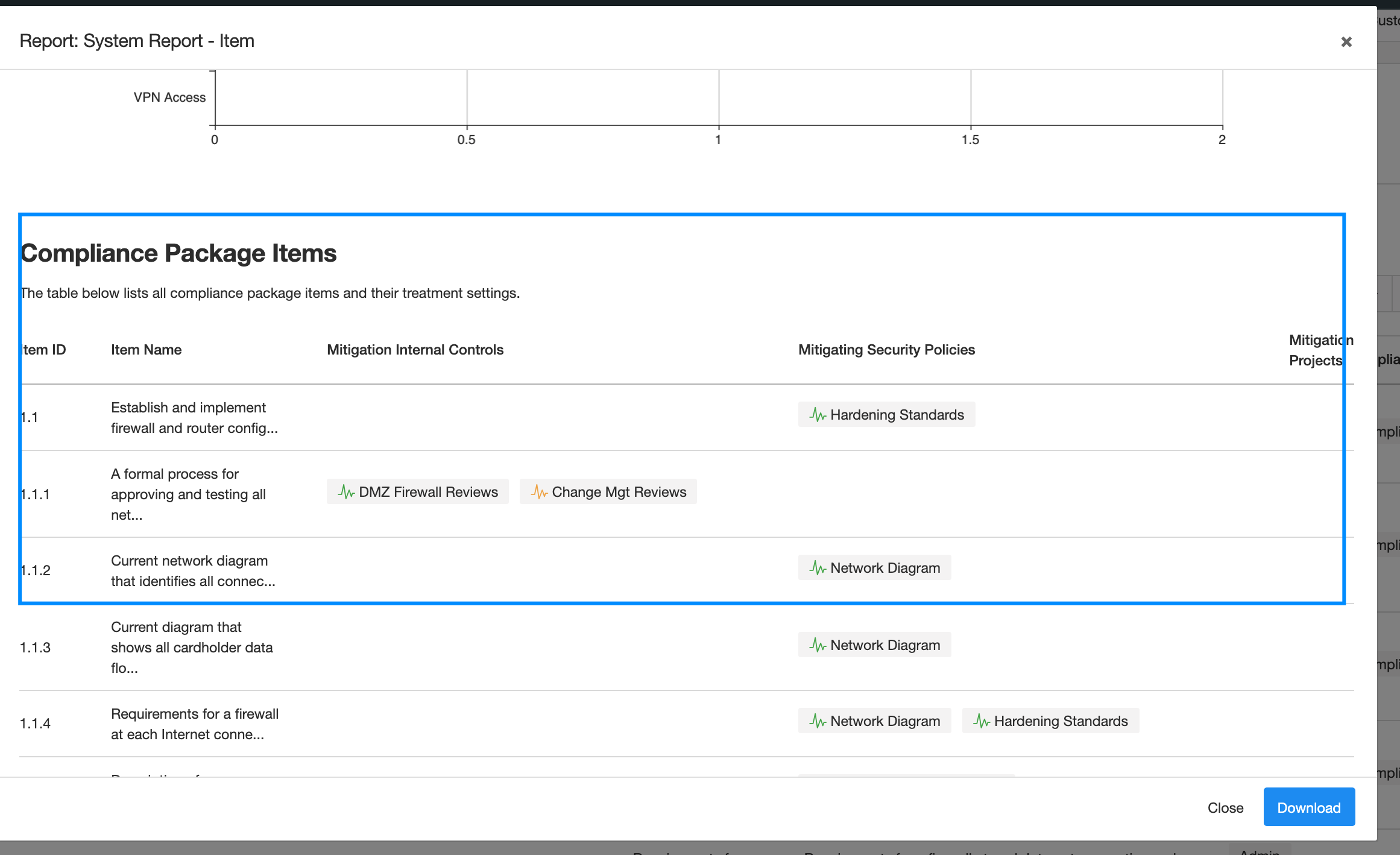
ps. sorry the screenshot above is for pci, but the same applies for ISO
is very important to understand con eramba works on terms of compliance !
---
### Author:  [@frans.rampen](https://discussions.eramba.org/u/frans.rampen)
#### Post date: [November 27, 2020, 5:19pm UTC](https://discussions.eramba.org/t/question-iso27001-statement-of-applicability/610/3 "2020-11-27T17:19:27Z")
For the pas 3 audits within our customers company the Auditor mentioned eramba not able to provide SOA WITHOUT manually altering documents. Upon the next audit (which is fulll ISO27001 certification path) he advised to get in contact with eramba to have this solved.
Currently we build the SOA by opening the system report - items. This will give a good overview of all compliant items with their mitigations. The items not compliant are not applicable within the organization, so they added them to the Compliance Exceptions page in eramba, using “Description” field to explain why it is non-applicable.
REQUEST: Can the System Item report be altered so it contains current information extended with table overview of all compliance exceptions using item ID, Name and Description fields?
The current behaviour is somewhat strange though:
- when we download the system report - item of a compliance exception we get a PDF with only the selected exception
- when we download the system report - item of a compliance item (page compliance analysis) we get a PDF wilth ALL compliancy items of the compliance package,
So i would assume, as we select only one compliancy item, it would generate a PDF with only the selected ittem
We could use the current report including all compliant items and all compliant exceptions as a new submenu option
Regards,
Frans
---
### Author:  [@eramba](https://discussions.eramba.org/u/eramba)
#### Post date: [November 27, 2020, 5:46pm UTC](https://discussions.eramba.org/t/question-iso27001-statement-of-applicability/610/4 "2020-11-27T17:46:02Z")
hello,
im not sure i understand, you miss a compliance exception description column on your filter ?

something like that?
regards
---
### Author:  [@frans.rampen](https://discussions.eramba.org/u/frans.rampen)
#### Post date: [November 27, 2020, 6:38pm UTC](https://discussions.eramba.org/t/question-iso27001-statement-of-applicability/610/5 "2020-11-27T18:38:02Z")
Boy i’m happy with your post:-) I didn’t know i could add these columns but found it. Also i was able to make a new item report with all columns except one: Exception Description. So it would be very welcome to have this description field selectable inside the report designer!
With that change we can generate a ISO27001 SOA right from eramba
EDIT: nevermind, i can use the Title field of the exception just like internal control and security policy. So all good to go!
---
### Author:  [@eramba](https://discussions.eramba.org/u/eramba)
#### Post date: [November 27, 2020, 7:54pm UTC](https://discussions.eramba.org/t/question-iso27001-statement-of-applicability/610/6 "2020-11-27T19:54:01Z")
any filter (saved) can be shown on a report , because when you add a “Filter” widget on a report you basically. select which filter you want included.
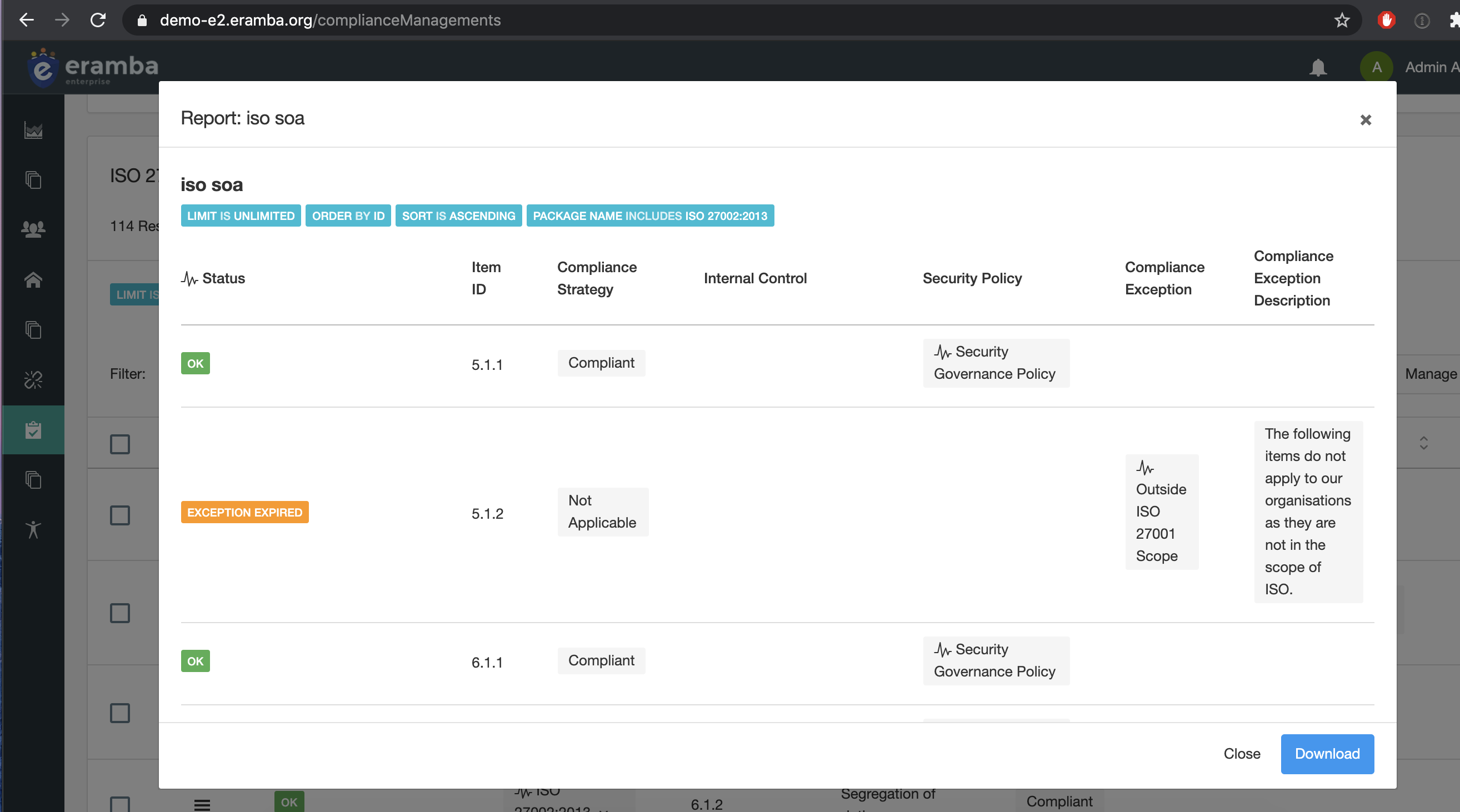
- create a filter with the conditions and columns you want
- save it
- add an item report
- select the filter widget, select the filter
- add anything else you want
- done
that is a custom filter showing only a few columns (otherwise the with would exceed the A4 limit of the report) .. i think that is what you mean but maybe im wrong
---
### Author:  [@frans.rampen](https://discussions.eramba.org/u/frans.rampen)
#### Post date: [December 4, 2020, 6:41pm UTC](https://discussions.eramba.org/t/question-iso27001-statement-of-applicability/610/7 "2020-12-04T18:41:41Z")
Tnx for the explaination. I talked to my reviewer and the report is ok, except it needs the date of creation and a version number displayed. Are there any general macro’s available for the current date and maybe a version string = custom date format?
---
### Author:  [@w.franke](https://discussions.eramba.org/u/w.franke)
#### Post date: [February 28, 2022, 9:50am UTC](https://discussions.eramba.org/t/question-iso27001-statement-of-applicability/610/8 "2022-02-28T09:50:12Z")
I’d concur.
Having the possibility to add a date or timestamp to any report would help to use them with (asset/risk owners) or in the certification
---
### Author:  [@dzl](https://discussions.eramba.org/u/dzl)
#### Post date: [February 28, 2022, 4:52pm UTC](https://discussions.eramba.org/t/question-iso27001-statement-of-applicability/610/9 "2022-02-28T16:52:37Z")
Would be a great addition to have this.
---
### Author:  [@eramba](https://discussions.eramba.org/u/eramba)
#### Post date: [February 28, 2022, 4:59pm UTC](https://discussions.eramba.org/t/question-iso27001-statement-of-applicability/610/10 "2022-02-28T16:59:01Z")
> [@w.franke](#):
>
> date or timestamp to any report
you mean pdf stuff you download, right ?
---
### Author:  [@dzl](https://discussions.eramba.org/u/dzl)
#### Post date: [February 28, 2022, 6:27pm UTC](https://discussions.eramba.org/t/question-iso27001-statement-of-applicability/610/11 "2022-02-28T18:27:51Z")
Yes PDF report downloads was what I was inferring.
---
### Author:  [@eramba](https://discussions.eramba.org/u/eramba)
#### Post date: [March 2, 2022, 6:51am UTC](https://discussions.eramba.org/t/question-iso27001-statement-of-applicability/610/12 "2022-03-02T06:51:15Z")
ok - we’ll include on the top right corner of every page:
Report generated by $user on $date (14th March 2022) using eramba
Int. ref.: [https://github.com/eramba/eramba\_v2/issues/3380](https://github.com/eramba/eramba_v2/issues/3380)
---
### Author:  [@eramba](https://discussions.eramba.org/u/eramba)
#### Post date: [March 3, 2022, 10:51am UTC](https://discussions.eramba.org/t/question-iso27001-statement-of-applicability/610/13 "2022-03-03T10:51:44Z")
this is how is going to look

---
### Author:  [@dzl](https://discussions.eramba.org/u/dzl)
#### Post date: [March 3, 2022, 10:59am UTC](https://discussions.eramba.org/t/question-iso27001-statement-of-applicability/610/14 "2022-03-03T10:59:49Z")
Looks good to me 👌
Is that going to be global across all reports?